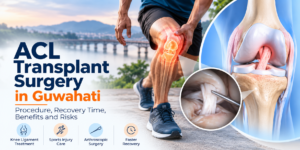
A sudden twist of the knee while playing football, cricket, badminton, or running can cause a serious knee injury. Sometimes, the pain and swelling improve within a few days. However, if your knee continues to feel unstable or gives way while walking, climbing stairs, or changing direction, you may have an injury to the anterior cruciate ligament (ACL).
ACL injuries are common among people who play sports, but they can also happen during everyday activities. When the ligament is badly torn, some patients may need surgery to restore knee stability and return to their normal activities.
If you are looking for ACL transplant surgery in Guwahati, understanding the treatment options, surgical procedure, and recovery process can help you make an informed decision.
At NE Ortho Care, Guwahati, patients can explore orthopaedic care for knee ligament injuries, sports injuries, and arthroscopic procedures under the guidance of Dr. Samarjit Khanikar.
In this article, we explain what ACL transplant surgery means, when surgery may be necessary, how the procedure is performed, and what patients should know about recovery.
What Is ACL Transplant Surgery?
ACL transplant surgery is a term commonly used by patients when referring to ACL reconstruction surgery. The standard medical term for this procedure is anterior cruciate ligament reconstruction.
The ACL is one of the main ligaments inside the knee joint. It connects the thigh bone (femur) to the shin bone (tibia) and helps control knee movement. It is especially important when you run, jump, turn, or suddenly change direction.
When the ACL tears, the knee may lose some of its stability. A person may experience pain, swelling, difficulty walking, or a feeling that the knee is slipping.
During ACL reconstruction surgery, the damaged ligament is replaced with a tissue graft. This graft may come from a tendon in the patient’s own body or, in selected cases, from donated human tissue.
The new graft acts as a replacement ligament and gradually integrates with the surrounding tissues. The main goal is to improve knee stability and support a safe return to daily activities and sports.
What Causes an ACL Tear?
An ACL tear often happens when the knee experiences a sudden twisting movement or an unexpected change in direction.
Common causes include:
- Suddenly stopping while running.
- Changing direction quickly during football or basketball.
- Landing awkwardly after jumping.
- Twisting the knee while playing badminton or cricket.
- Falling or sustaining a sports-related injury.
- Road accidents or other traumatic injuries.
An ACL injury does not always require surgery. The right treatment depends on the severity of the tear, knee stability, other injuries, and the patient’s lifestyle.
People who participate in sports involving sudden turns and pivoting movements may have a higher risk of ACL injuries.
What Are the Symptoms of an ACL Injury?
Recognising the symptoms of an ACL injury can help you seek medical attention at the right time.
1. Sudden Knee Pain
Many patients experience pain immediately after twisting or injuring the knee. The severity varies depending on the injury and whether other structures are affected.
2. Swelling Around the Knee
Swelling may develop within a few hours of the injury. Rapid swelling following a twisting injury should be assessed by a medical professional.
3. A Popping Sound
Some people report hearing or feeling a pop when the ACL tears. However, the absence of this sound does not rule out an ACL injury.
4. Knee Instability
One of the common symptoms is a feeling that the knee may give way while walking, turning, or changing direction.
5. Difficulty Playing Sports
Running, jumping, and sudden movements may become difficult because the knee no longer feels stable.
These symptoms can also occur with meniscus tears and other knee injuries. An orthopaedic examination and appropriate imaging, such as an MRI when indicated, can help determine the cause.
If you experience significant swelling, severe pain, or difficulty putting weight on your leg after an injury, seek medical assessment promptly.
When Is ACL Transplant Surgery Necessary?
Not every patient with an ACL tear needs surgery. Some people can manage their condition with physiotherapy, strengthening exercises, and changes to their activities.
However, an orthopaedic surgeon may recommend ACL reconstruction when:
- The knee repeatedly gives way during daily activities.
- The patient wants to return to sports involving twisting and pivoting.
- Knee instability continues despite appropriate rehabilitation.
- Other injuries, such as certain meniscus tears, also require surgical treatment.
- The patient’s work or lifestyle requires a high level of knee stability.
The decision should be based on the patient’s symptoms, examination findings, activity goals, and overall health.
For example, a person who regularly plays football may need a different treatment plan from someone who performs mostly sedentary work and has a stable knee.
If you have an ACL injury, consult an orthopaedic specialist in Guwahati to understand whether non-surgical treatment or ACL reconstruction is appropriate for you.
Types of Grafts Used in ACL Reconstruction Surgery
The graft is the tissue used to replace the damaged ACL. The choice depends on several factors, including the patient’s age, activity level, sporting goals, and medical history.
1. Autograft: Using Your Own Tendon
An autograft uses a tendon taken from another part of the patient’s body.
Common options include:
Hamstring tendon graft: Tissue is taken from tendons at the back of the thigh. This is one of the commonly used graft options for ACL reconstruction.
Patellar tendon graft: The central portion of the tendon connecting the kneecap to the shin bone is used.
Quadriceps tendon graft: A portion of the tendon above the kneecap is used to reconstruct the ligament.
Each option has its own benefits and possible disadvantages. For example, some patients may experience discomfort at the front of the knee after a patellar tendon graft, while other graft choices have their own recovery considerations.
2. Allograft: Using Donor Tissue
An allograft uses donated human tissue that has been processed for medical use. It avoids the need to take a tendon from the patient’s own body.
An allograft may be considered in selected cases, including certain revision surgeries. However, it may have a higher risk of failure in some young, active patients, particularly those returning to demanding sports.
The most appropriate graft depends on the patient’s individual needs. The surgeon should explain the available options, benefits, and risks before surgery.
How Is ACL Transplant Surgery Performed?
ACL reconstruction is commonly performed using arthroscopy. This technique allows the surgeon to operate inside the knee through small incisions using a camera and specialised instruments.
The procedure generally involves the following steps.
Step 1: Anaesthesia
The patient receives suitable anaesthesia so that the procedure can be performed comfortably. The anaesthesia plan depends on the patient’s health and the surgical team’s assessment.
Step 2: Examination of the Knee
The surgeon examines the knee joint and checks for associated injuries involving the meniscus, cartilage, or other ligaments.
Step 3: Preparation of the Graft
The selected tendon graft is prepared for use as the replacement ACL. If an autograft is chosen, the tendon is taken from the patient’s own body.
Step 4: Arthroscopic Reconstruction
Small incisions are made around the knee. The surgeon uses a camera to examine the joint and creates tunnels in the thigh bone and shin bone to position the graft correctly.
Step 5: Fixation of the Graft
The graft is passed through the tunnels and secured using suitable fixation devices. Its position and tension are checked before the procedure is completed.
Step 6: Postoperative Care
After surgery, the patient is monitored while recovering from anaesthesia. The care team provides instructions about wound care, pain management, walking, and rehabilitation.
The exact surgical technique depends on the injury, the chosen graft, and the surgeon’s assessment.
How Long Does ACL Surgery Recovery Take?
Recovery after ACL transplant surgery is gradual. Although the operation helps restore mechanical stability, the graft needs time to heal, and the muscles around the knee need to regain strength.
The recovery period varies from person to person.
First Two Weeks
The main goals are to control swelling, improve knee movement, and activate the thigh muscles. Crutches or a knee brace may be recommended depending on the patient’s condition and surgical plan.
Two to Six Weeks
Physiotherapy focuses on improving movement, walking, muscle control, and balance. Progress depends on the patient’s recovery and whether additional procedures were performed.
Two to Four Months
The rehabilitation programme may include more challenging strengthening and balance exercises. Some patients may begin carefully controlled low-impact activities when their surgeon and physiotherapist consider them ready.
Four to Six Months
Patients may progress to more demanding exercises, depending on their strength, knee movement, and functional ability. Running or other higher-impact activities should only begin when appropriate clinical criteria are met.
Six to Twelve Months or Longer
Returning to sports that involve jumping, twisting, or sudden changes of direction may take nine to twelve months or longer. The exact timeline varies according to the patient’s progress, strength, knee stability, and functional testing.
Do not return to sports based on time alone. Your surgeon and physiotherapist should assess your strength, knee stability, movement control, and readiness before clearing you for demanding activities.
Following the rehabilitation plan carefully is an important part of achieving the best possible outcome.
What Are the Benefits of ACL Reconstruction Surgery?
For patients with significant knee instability, ACL reconstruction may provide several benefits.
These include:
- Improved knee stability during movement.
- Fewer episodes of the knee giving way.
- Better ability to participate in appropriate physical activities.
- Support for a structured return to sports.
- The opportunity to treat associated knee injuries when necessary.
However, surgery does not guarantee a complete return to the patient’s previous level of performance. Results depend on the injury, graft choice, rehabilitation, and other individual factors.
ACL reconstruction also cannot completely eliminate the risk of developing osteoarthritis in the future.
Your orthopaedic surgeon can explain the likely benefits of surgery in relation to your symptoms, activity level, and treatment goals.
What Are the Risks of ACL Transplant Surgery?
Like every surgical procedure, ACL reconstruction carries certain risks.
Possible complications include:
- Infection around the surgical site or inside the knee.
- Blood clots in the leg.
- Persistent pain or swelling.
- Knee stiffness or difficulty fully straightening the leg.
- Weakness at the tendon graft collection site.
- Graft stretching or failure.
- Another ACL injury.
- Difficulty returning to the previous level of sports performance.
The risk varies according to the patient’s health, the type of injury, the surgical procedure, and other factors.
Discuss the potential benefits and risks with your orthopaedic surgeon before deciding on treatment. Following medical advice and completing rehabilitation can help support a safer recovery.
Is Physiotherapy Necessary After ACL Transplant Surgery?
Yes. Physiotherapy is a central part of ACL reconstruction treatment.
Surgery can restore the mechanical stability of the knee, but it cannot automatically restore muscle strength, balance, coordination, or confidence.
A structured rehabilitation programme may include:
- Exercises to restore knee movement.
- Quadriceps and hamstring strengthening.
- Balance and coordination training.
- Walking and movement retraining.
- Gradual sports-specific training when appropriate.
Patients should follow their rehabilitation plan and avoid increasing activity too quickly. Skipping physiotherapy or returning to sports before the knee is ready can increase the risk of complications and further injury.
The rehabilitation programme should be adjusted according to the patient’s progress and the surgeon’s instructions.
How Can You Prepare for ACL Reconstruction Surgery?
Preparing for surgery can make the treatment and recovery process more organised.
Before the operation, consider the following steps:
- Discuss your symptoms: Explain how the injury occurred, what movements cause pain, and whether your knee feels unstable.
- Understand your treatment options: Ask whether physiotherapy alone may be suitable or whether surgery is recommended.
- Discuss graft selection: Ask which graft is appropriate for your age, activity level, and sporting goals.
- Follow pre-operative instructions: Take medicines and prepare for surgery according to your medical team’s advice.
- Plan for recovery: Arrange help at home if needed, particularly during the initial period when walking may be difficult.
- Understand rehabilitation: Ask about physiotherapy, follow-up appointments, and the expected recovery milestones.
In some cases, the surgeon may recommend reducing swelling and restoring knee movement before surgery. The timing depends on the injury and the patient’s condition.
ACL Transplant Surgery in Guwahati at NE Ortho Care
If you are experiencing knee instability, persistent pain after a sports injury, or difficulty returning to your regular activities, an orthopaedic assessment can help identify the cause and determine the appropriate treatment.
At NE Ortho Care, Guwahati, patients can explore orthopaedic care for knee ligament injuries, sports injuries, and arthroscopic procedures under the guidance of Dr. Samarjit Khanikar.
For people searching for ACL transplant surgery in Guwahati, understanding the diagnosis and available treatment options is an important first step.
During your consultation, you can discuss your symptoms, examination findings, whether ACL reconstruction may be appropriate, graft options, expected recovery time, and rehabilitation requirements.
Every knee injury is different, and not every ACL tear requires an operation. A proper clinical evaluation is important before deciding on treatment.
To enquire about an appointment at NE Ortho Care, Guwahati, contact our clinic or use the appointment enquiry options available on this website.
Frequently Asked Questions About ACL Transplant Surgery
1. Is ACL transplant surgery the same as ACL reconstruction?
The term ACL transplant surgery is commonly used to describe ACL reconstruction. The procedure replaces the damaged ligament with a tendon graft, which may come from the patient’s own body or donated tissue.
2. How long does ACL transplant surgery take?
The duration depends on the surgical technique and whether other knee injuries need treatment. Your surgeon can explain the expected procedure time based on your condition.
3. Can I walk after ACL reconstruction surgery?
Many patients begin walking with assistance soon after surgery, depending on their condition and the surgeon’s instructions. Crutches or a brace may be required during the initial recovery period.
4. How long does it take to return to sports after ACL surgery?
Returning to demanding sports often takes nine to twelve months or longer. The decision should depend on rehabilitation progress and functional testing, not just the number of months since surgery.
5. Does every ACL tear require surgery?
No. Some patients can manage an ACL tear with physiotherapy and activity modification. Surgery may be recommended for persistent instability or when the patient’s activity goals and associated injuries make reconstruction appropriate.
6. What is the difference between ACL repair and ACL reconstruction?
ACL repair attempts to preserve and reattach suitable torn ligament tissue in selected cases. ACL reconstruction replaces the damaged ligament with a graft. The appropriate procedure depends on the injury pattern and clinical assessment.
7. How can I find ACL treatment in Guwahati?
If you are looking for ACL injury assessment or reconstruction options in Guwahati, you can enquire with NE Ortho Care about its orthopaedic services and arrange a consultation to discuss your condition.
Conclusion
ACL transplant surgery, more commonly called ACL reconstruction, can help restore knee stability in patients with a significant ACL tear. The procedure involves replacing the damaged ligament with a tendon graft, followed by a structured rehabilitation programme.
However, successful treatment involves more than surgery alone. Accurate diagnosis, appropriate treatment selection, careful postoperative care, and regular physiotherapy all play important roles in recovery.
If you have persistent knee instability, pain after a twisting injury, or difficulty returning to your usual activities, seek an assessment from a qualified orthopaedic surgeon.
At NE Ortho Care, Guwahati, patients can discuss their knee problems and explore appropriate orthopaedic treatment options under specialist guidance. Contact our clinic to enquire about an appointment and take the next step towards understanding your knee health.
Medical disclaimer: This article is intended for general educational purposes and does not replace an individual medical consultation. Diagnosis and treatment decisions should be made with a qualified orthopaedic specialist.